
A booth seller in Yiwu decides what to quote you before you finish your first sentence. Yiwu market negotiation is not about arguing over numbers. It is about what you signal in the first thirty seconds: whether you know your quantity, whether you have bought here before, and whether you look like a tourist or a trader. Here are six rules for booth prices, the three price levels behind every quote, and why pushing too hard costs you quality instead of cash.
The honest answer about booth prices
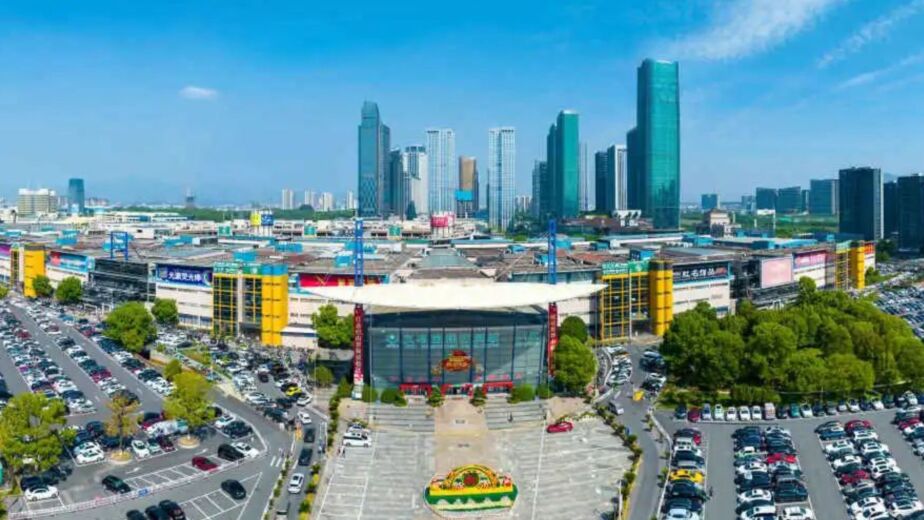
Prices in the Yiwu International Trade City are flexible, but not random. Across 5 main districts and 75,000+ booths, almost every booth sits in front of a factory that sets a floor, and nobody sells below it for long. What moves in a Yiwu market negotiation is the gap between that floor and the number the seller says out loud. That gap is decided by what the seller believes you will buy, not by how hard you argue.
The three price levels behind a quote
Every number at a booth sits on one of three levels, set by what you have shown the seller.
| Price level | Who hears this number | What moves it |
|---|---|---|
| Opening quote | Anyone who asks the price before naming a quantity | Naming a real quantity |
| Volume price | Buyers with a quantity and a written specification | A bigger order, packaging fixed in writing |
| Market price | Regulars the booth expects to see again | Repeat orders over years, not one conversation |
| Below the floor | Buyers who push past the factory floor | Nothing. The seller changes the goods instead |
Six rules for Yiwu market negotiation at the booth
The rules fall into two halves: before a price is named, and after.
Rules 1 to 3: before a price is named
- Open with a quantity, not a price. “How much is this?” is the tourist question, and it gets the tourist quote. “What is your price at 3,000 pieces?” tells the seller you are buying, and the first number you hear will already be lower.
- Learn the three price levels. There is the opening quote given to strangers, the volume price offered once a real quantity is on the table, and the market price a regular pays. Most visitors bargain hard and still land at level two. That is normal, not a failure.
- Let the calculator do the talking. Where there is no shared language, the booth calculator is the language. The seller types a number and slides it across. You clear it, type yours, slide it back. Two or three rounds and you have a price. Use whole numbers rather than tiny cuts, and write the quantity beside the price so nobody is negotiating a different order.
Rules 4 to 6: once a number is on the table
- Walk away, then come back. Leaving a booth without buying is not rude in Yiwu, and sellers do not resent it. Buyers are expected to compare four or five booths in the same corridor. Returning an hour later reads as interest, not weakness.
- Confirm what the price includes. Inner boxes, export cartons, logo printing and carton marks are separate line items here. A lower unit price with no export packaging is not a lower price. Ask for the pieces per carton and the carton size too: two quotes are not comparable until both are packed the same way.
- Stop before the product changes. Once a seller reaches their floor, the next concession does not come out of margin. It comes out of the goods. If you still need a lower unit price, the lever is quantity, not another round of bargaining.
Why hard bargaining buys a worse product, not a better deal
The cost of pushing too far does not appear in the quote. It appears in the carton.
What a seller cuts when the price falls too far
Push a booth 30 percent under a genuine volume price and the seller will often agree. They then protect their margin the only way left: thinner plating, lighter fabric, a cheaper zip, fewer stitches, a flimsier blister card. You paid less per piece and received less product. The price fell and the value fell further.
Negotiate the specification first, the price second
The professional move is to negotiate the specification first and the price second. Fix the material, the weight, the packaging and the approved sample, then ask for a volume price against it. If the seller drops the price after that point, ask what changed. A written specification is also what makes a later quality inspection meaningful, because an inspector can only check goods against a written standard. If you are still planning a first visit, the Yiwu market guide explains how the districts are laid out.
Where Yiwu market negotiation needs a person on the ground
Two things sit outside what a week at the market can build: the language across the counter, and the history behind the number.
Relationships move prices further than tactics
Technique has a ceiling. The layer a blog cannot hand you is the one that runs in Yiwu dialect with a booth owner who recognises your face. Relationships move prices further than any tactic, and they are built over years of repeat orders, not in one visit.
What a local buyer adds
That is where a buyer already based in the city earns their keep. Pioneer Group works from an office in Yiwu with access to 5,000+ factories, charges 3 to 5 percent commission depending on order quantity, and adds no hidden markup on goods. Minimum order value is US$5,000.
Frequently asked questions
Is Yiwu market negotiation different from negotiating with a factory?
Yes. A booth quotes fast and expects a same-day decision, while a factory quotes against a specification and a schedule. Pioneer Group works with both and matches the order to whichever route fits the quantity.
How much discount should I realistically expect?
There is no fixed percentage. A successful Yiwu market negotiation moves you from the stranger quote to the volume price for your quantity. Chasing below that usually changes the product, not the price.
Do I need to speak Chinese to negotiate at a booth?
No. A calculator, clear quantities and a written specification carry most of a Yiwu market negotiation. The final layer is linguistic and relational, which Pioneer Group handles locally, replying within 2 hours during business hours, China time.
How Pioneer Group can help
Booth pricing across 5 districts and 75,000+ stalls rewards buyers who know the going rate. Our team negotiates on site in Chinese and passes the supplier price through, with our 3 to 5 percent commission shown separately.
- Sourcing. Access to 5,000+ factories from an office in Yiwu, so you deal with the maker instead of a reseller.
- Quality inspection. Three stages, raw material, in production and pre shipment, with photo and video reports.
- Consolidation and shipping. Orders from many booths received at one warehouse and loaded as a single shipment.
Commission is 3 to 5 percent by order quantity, paid by you and never by the factory, with no hidden markup on the goods. Minimum order value is US$5,000. We reply within 2 hours during China business hours, in English, Chinese, Arabic, Russian, Turkish or French.
Talk to us: WhatsApp +86 190 2577 9716, info@pioneergptrading.com, or the contact form.
Pioneer Group is a China sourcing agent based in Yiwu, China, helping wholesale and bulk buyers source, inspect, consolidate, and ship orders from China.